
The "Heart" of Tricone Roller Bits: Three Core Bearing Types That Determine Drilling Efficiency
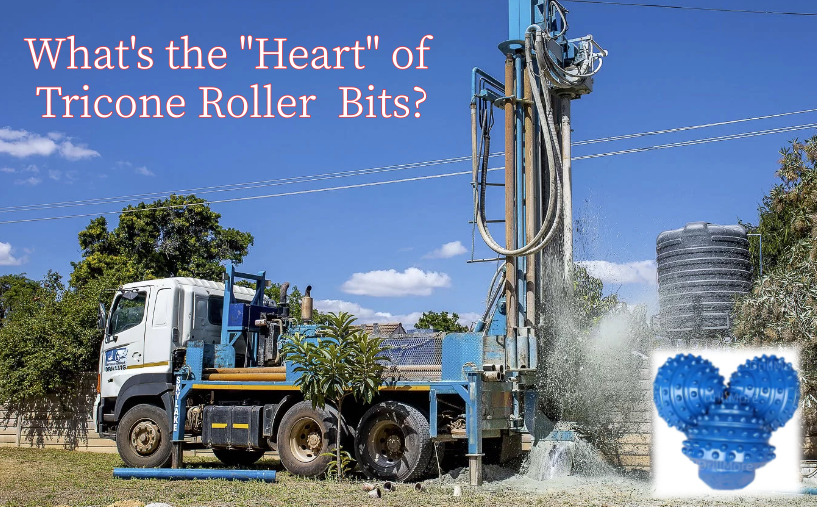
At oil and gas exploration and geological drilling sites, the roller cone bit is like a "steel beast" penetrating deep into the ground, and the bearing serves as the "heart" of this beast. It supports the high-speed rotation of the roller cones, endures complex underground pressures and friction, and directly determines the service life of the bit and the efficiency of drilling operations. Today, we will break down the three core bearing types of roller cone bits, exploring the technical secrets behind each and the scenarios where they excel.
I. Sliding Sealed Rubber Bearing: The Cost-Effective Champion, A Reliable Helper for Soft to Medium-Hard Formations
In conventional drilling scenarios, the sliding sealed rubber bearing is a seasoned "veteran" with a high utilization rate. Its structure is not complicated; the core consists of a sliding friction pair composed of an alloy steel journal and a wear-resistant alloy bushing. Like two precision-fitted metal components, it transmits power through sliding friction. To prevent the intrusion of drilling fluid, a dedicated rubber sealing assembly—such as radial seal rings and end gaskets—is installed on the outer side of the bearing cavity, and the cavity is filled with high-viscosity grease to form a "protective barrier."
The greatest advantages of this bearing lie in its "stability" and "cost-effectiveness." The sliding friction design enables uniform load distribution and superior impact resistance, allowing it to operate stably even under high drilling pressure and high rotational speed conditions. Additionally, it features low manufacturing costs and simple maintenance—after wear, only the bushing needs to be replaced to restore the bit to service. However, the rubber seal is its "weakness": its temperature resistance is generally no more than 120°C, and its pressure resistance limit is around 50MPa, making it ineffective in high-temperature deep wells or when exposed to corrosive drilling fluids.
Therefore, the "main battlefield" of sliding sealed rubber bearings is in soft to medium-hard formations, such as clay, sandstone, and limestone. They are particularly suitable for onshore conventional drilling, directional drilling, and shallow well operations where cost control is critical. If your drilling requirements align with these scenarios, this bearing will be an extremely cost-effective choice.
II. Rolling Sealed Rubber Bearing: The High-Efficiency Pioneer, A Key Tool for Medium-Hard to Hard Formations
When drilling shifts to medium-hard to hard formations, such as granite and basalt, the efficiency of sliding sealed rubber bearings becomes insufficient—and that's when rolling sealed rubber bearings take center stage. Its core improvement is replacing the traditional sliding friction pair with rolling elements (ball bearings or roller bearings). Both the rolling elements and the inner/outer rings are made of high-precision wear-resistant alloy, while retaining the rubber seal and grease-based sealing and lubrication system.
The most significant change brought by rolling friction is "reduced effort": friction resistance is greatly lowered, the bit's starting torque is smaller, and it can easily achieve higher rotational speeds. The mechanical drilling speed typically increases by 10%-30%, which is undoubtedly a core advantage for projects pursuing high-efficiency drilling. However, it also inherits the limitations of rubber seals—its maximum temperature resistance is slightly higher than that of sliding bearings, but only reaches 130°C, with a pressure resistance of approximately 60MPa. Furthermore, the rolling elements are highly sensitive to impurities; solid particles in the drilling fluid can easily cause jamming, so higher requirements are placed on the cleanliness of the drilling fluid.
Based on these characteristics, rolling sealed rubber bearings are mainly used for drilling in medium-hard to hard formations, such as the vertical sections of deep and ultra-deep wells, as well as high-efficiency drilling projects requiring high mechanical drilling speeds. In terms of drilling fluid selection, they are more compatible with clean water and low-solid-phase drilling fluid systems. To give full play to their high-efficiency advantages, the use of drilling fluids containing large solid particles should be avoided as much as possible.
III. Unsealed Rolling Air Bearing: The High-Temperature Resistant Expert, A Specialized Option for Unique Drilling Processes
In ultra-high temperature and ultra-high pressure deep drilling scenarios, such as geothermal wells and shale gas deep wells, the rubber seals of the first two bearing types will fail due to high temperatures. At this point, the unsealed rolling air bearing becomes the only viable solution. Its structural design is quite unique: it adopts a rolling element friction pair but completely eliminates the sealing assembly. The bearing cavity is directly connected to the drilling medium, and high-pressure air or atomized drilling fluid is used as the cooling and lubricating medium.
Without the constraints of seals, its temperature resistance has achieved a qualitative leap, reaching over 200°C, which is fully capable of adapting to ultra-high temperature underground environments. At the same time, high-pressure air continuously purges the bearing cavity, not only removing heat generated by friction but also effectively expelling intruding cuttings to avoid bearing wear, greatly improving reliability in harsh environments. However, it also has unique "requirements": it has extremely high demands on the air supply system, requiring a stable high-pressure air source. Moreover, the bearing life is directly affected by the cleanliness of the air source—if impurities mix into the air source, it can easily cause bearing damage.
This type of bearing has relatively specialized applications, mainly used in ultra-high temperature and ultra-high pressure deep well drilling, as well as special processes such as underbalanced drilling and air drilling. In these processes, high-pressure air not only provides lubrication and cooling for the bearing but also effectively prevents wellbore collapse, achieving two goals at once. It should be noted, however, that it is completely incompatible with conventional water-based drilling fluid systems and can only operate in gas or atomized drilling fluid media—this is its core application limitation.
Summary: How to Choose Among the Three Bearings? Matching Working Conditions Is the Key
After learning about the details of these three bearings, it is clear that there is no absolute superiority or inferiority among them—only differences in suitability for specific working conditions. In simple terms, the core logic for selection can be summarized in three points:
For soft to medium-hard formations and shallow well operations where cost-effectiveness is a priority, choose the sliding sealed rubber bearing; for medium-hard to hard formations where high drilling speed and efficiency are required, select the rolling sealed rubber bearing; and for ultra-high temperature, ultra-high pressure deep wells or special processes like air drilling, the unsealed rolling air bearing is the only option.
As the "heart" of the roller cone bit, bearing selection directly affects the cost, efficiency, and safety of drilling operations. It is hoped that this article will help you clarify the core differences among the three bearings, enabling you to choose the right "heart" for practical drilling projects and ensure efficient and reliable drilling every time.
Your email address will not be published. Required fields are marked with *


