
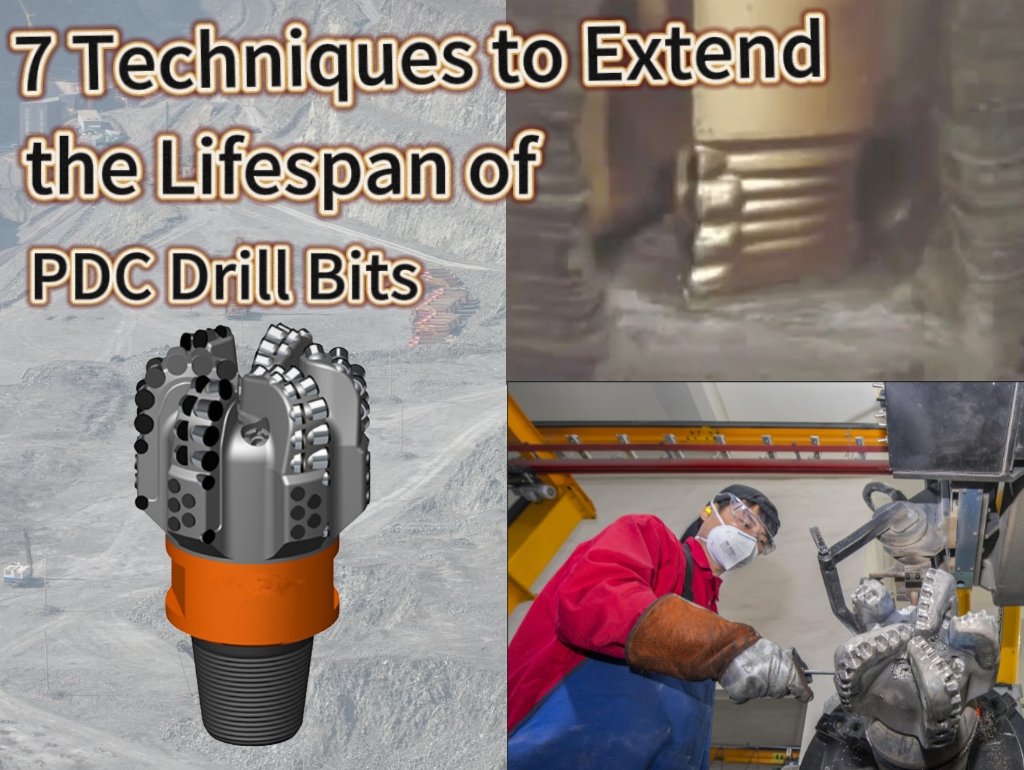
7 Field Techniques to Extend the Lifespan of PDC Drill Bits
1. Apply Weight Gradually to Avoid Impact Load
Issue: Although PDC cutters are extremely hard, they have low impact resistance. Sudden weight application can cause composite sheet chipping.
Solution:
Use a "step-by-step weight application" strategy: Start with 30% of the recommended weight on bit (WOB), then increase by 20% every 10 minutes until reaching the optimal WOB.
Monitor torque fluctuations (via MWD/LWD tools). If fluctuations exceed 15%, reduce WOB.
Scientific Basis: The thermal expansion coefficients of the diamond layer and tungsten carbide substrate differ, leading to microcracks at the interface under impact loads (SPE 168973 study).
2. Optimize RPM and WOB Matching
Issue: High RPM + low WOB causes cutters to "grind" rather than "shear" the formation, accelerating wear. Low RPM + high WOB may induce stick-slip vibration.
Solution:
Refer to the "Specific Energy (SE)" formula:
SE = \frac{WOB \times RPM}{ROP \times D^2}
(ROP: Rate of Penetration, D: Bit Diameter)
Adjust RPM/WOB if SE values rise abnormally.
Soft formations: High RPM + medium-low WOB (e.g., 60-80 RPM + 8-12 klbs).
Hard formations: Low RPM + high WOB (e.g., 30-50 RPM + 15-20 klbs).
3. Control Drilling Fluid Properties to Prevent Balling & Thermal Damage
Issue: High sand content or low viscosity in drilling fluid can cause:
Cuttings accumulation (bit balling) → inadequate cooling → thermal degradation of cutters.
High flow rates eroding the bit body.
Solution:
Maintain drilling fluid yield point (YP) at 15-25 lb/100ft² for effective cuttings transport.
Use nano-scale bridging agents (e.g., SiO₂ particles) to reduce bit balling (OTC 28921 experimental data).
Monitor outlet temperature; if exceeding 150°C, increase flow rate or add extreme-pressure lubricants.
4. Avoid Forced Drilling in Interbedded Formations
Issue: PDC bits in alternating hard/soft formations (e.g., sand-shale sequences) are prone to lateral vibrations, causing gauge wear or broken cutters.
Solution:
Analyze offset well logs in advance to identify interbedded zones.
Reduce ROP by 20% and switch to constant WOB mode if torque fluctuations are frequent.
Use hybrid bit designs (e.g., backup cutters) for enhanced impact resistance.
5. Perform Short Trips to Clean the Wellbore
Issue: Cuttings buildup at the bottom leads to re-cutting, reducing efficiency and accelerating gauge wear.
Solution:
Conduct a short trip (to the casing shoe) every 150-200 meters drilled.
Circulate drilling fluid for at least 2 cycles before pulling out, ensuring annular cleanliness (verify with a cuttings bed monitor).
6. Identify and Mitigate "Bit Dulling" Formations
Issue: In brittle formations with >40% quartz content, PDC bits may "skate" (rotate without penetrating).
Solution:
Switch to non-planar PDC bits (e.g., axe-shaped or conical cutters) for better formation engagement.
Inject silicate-based drilling fluid to temporarily seal microfractures and improve cuttings removal.
If skating persists for >30 minutes, pull out and replace with a roller cone or impregnated bit.
7. Follow Proper Tripping Procedures to Prevent Mechanical Damage
Issue: Collisions with casing or wellbore walls can cause diamond layer spalling.
Solution:
Limit tripping speed to <0.5 m/s, especially in doglegs >10°/30m.
Use bit protectors (e.g., rubber thread protectors) during transport and storage.
Circulate for 10 minutes before reaching bottom to remove settled cuttings.
DrillMore Bit Tools – Your Full-Lifecycle Technical Partner for PDC Bits
Your efficient drilling starts with our scientific support! We not only provide high-performance PDC bits but also offer a free exclusive technical package:
1. Intelligent Parameter Manual: Contains WOB/RPM matching matrices for 7 working conditions, enabling you to lock in optimal drilling parameters in 30 seconds.
2. Anti-Damage Solution Library:
Anti-sludging technology for nano-coated bits
Vibration suppression procedures for alternating formations
Real-time handling guidelines for "slippage" in quartz formations
3. Full-Process Protection: Including wellbore cleaning standards and anti-collision tripping regulations

Your email address will not be published. Required fields are marked with *


