
Dangerous Mismatch: Specifications, Tapers and Threads of Drilling Rigs and Drill Tools
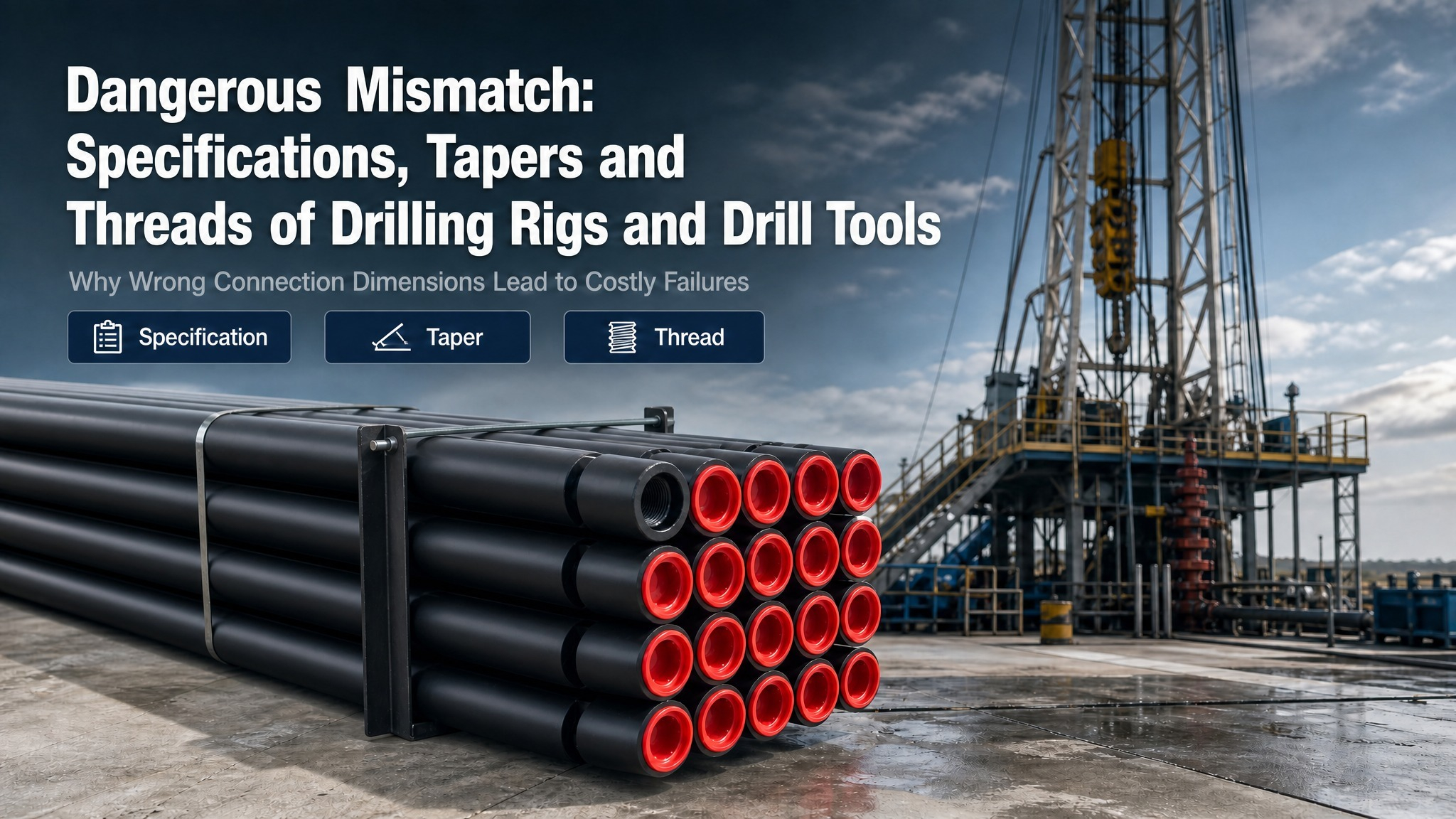
Dangerous Mismatch: Specifications, Tapers and Threads of Drilling Rigs and Drill Tools
Pitfall 1: Mismatch between Torque, Rotational Speed and Allowable Capacity of Drill Pipe
Many construction sites take "roughly matching" as proper matching. In fact, the load capacity of drill pipe is clearly marked on the manufacturer’s nameplate. Take the common Φ89 mm drill pipe as an example. For 35CrMo drill pipe specified in Chinese national standard GB/T 9808-2008, the allowable torque is 6800 N·m at a wall thickness of 9 mm, while it drops to only 5300 N·m at 7 mm wall thickness, a difference of 22%. If the output torque of the drilling rig exceeds 1.2 times the drill pipe limit and continuous operation lasts over 8 hours, microcracks will most likely form on the tool joint threads, invisible to naked eyes.
Rotational speed is another hidden variable. For Φ89 drill pipe, the manufacturer recommends a maximum speed of 180 r/min for air reverse circulation drilling and 120 r/min for mud positive circulation. Some sites set the rotary table at 250 r/min and gain higher penetration rate. The rate of penetration rises by 30%, yet the drill pipe bears 40% more alternating stress every minute, cutting its service life in half. Recommendation: Verify before each spud-in with this formula:
Rig rated torque × 0.8 ≥ drill pipe allowable torque ≥ torque required by drill bit
All three values must fall within the same range; none can be omitted.
Pitfall 2: Mismatched Taper and Threaded Connections
Common tapers for drill pipe threads include 1:4, 1:6 and 1:8. There are four API standard numbered connections: NC26, NC31, NC38 and NC46, each corresponding to a different torque range. Mr. Chen from Nanyang, Henan learned this lesson the hard way. When he took over a project, the site stock had used NC38 drill pipes, while the newly delivered rig was fitted with NC46 crossover subs. Forced connection caused 18% torque transmission loss and thread slippage. Worse still, mismatched tapers produce abnormal noise under high torque. Workers misdiagnosed it as bearing failure and shut down for inspection three times. The drill pipe suffered 30% wear before replacement.
There is an even more subtle pitfall on site: drill pipes from different batches at the same site are labeled NC38, yet one batch uses 60° thread flank angle and the other uses 55°. This "looks identical but fails to make up" scenario is quite common. Experienced site mechanics use thread go/no-go gauges to inspect every pipe before warehousing. Non-conforming pieces must be marked separately and prohibited from running downhole.
Pitfall 3: One-sided Overload from Mismatched Bit Specification and Rig Output
Bit diameter, drill pipe outer diameter and hoisting capacity of the rig form a triangular relationship. At a jobsite in Jining, Shandong, workers matched a Φ150 bit with Φ73 drill pipe, thinking a thin pipe could drive a large bit for convenience. When the bit hit hard rock at 50 m depth, the drill pipe instantly suffered torque overload. Three thread teeth fractured, and the broken joint still carried a quarter-turn section of the bit. Post-failure measurement shows the recommended ratio of drill pipe OD to bit diameter shall not be less than 1:2. A Φ150 bit requires at minimum Φ89 drill pipe.
Nozzle matching is another critical detail. For air drilling, the total nozzle area of the drill bit must match the air compressor displacement. The rule of thumb: 80–120 mm² nozzle area per 1 m³/min compressor discharge volume. For a 30 m³/min air compressor, total bit nozzle area should be 2400–3600 mm². Too small nozzles cause backpressure, insufficient bit cooling; oversized nozzles fail to maintain air pressure and leave cuttings poorly cleaned.
On-site Checklist: Start Drilling Only After Verifying These 5 Figures
Mr. Qian summarized these 5 key figures in internal training materials: torque, rotational speed, taper, thread, nozzle. They form the baseline for matching and must be checked before every new borehole. Inspection steps are straightforward:
Compare torque values between rig nameplate and drill pipe nameplate; deviation ≤10%
Set rotational speed below the upper limit specified in the drill pipe manufacturer manual
Measure taper and threads directly with vernier calipers and thread go/no-go gauges
Calculate total nozzle area: measure width of each nozzle with caliper, multiply by nozzle quantity and sum up
New operators often overlook mixed runs of new and used drill pipes. Worn threads on old pipes and intact threads on new pipes create stress concentration at threaded connections, which almost always leads to failure in deep holes.
Mr. Zhao worked on a project at the northern foot of the Qinling Mountains last year. He ran mixed new and used Φ89 drill pipes. After drilling to 120 m, the joint parted at 60 m depth. Fishing cost 23,000 RMB and delayed construction for 22 days. Later he figured out the limit for mixing new and used drill pipe: same-batch drill pipes have thread engagement deviation of ±0.05 mm, while mixed new/used string can reach ±0.2 mm.
Closing Remarks: Matching Is Not Mysticism — It Is All About Numbers
Replace "it’s roughly okay" with "the numbers match", and you truly get full control of your equipment. Matching drilling rig and drill tools is not experience-based guesswork. It requires line-by-line alignment of five parameters: torque, rotational speed, taper, thread and nozzle. Behind each parameter lie costly lessons from countless fishing operations. Spend 10 minutes verifying these five items before spudding next time. It is far more economical than paying 18,000 RMB for fishing work and losing 22 days of construction downtime.
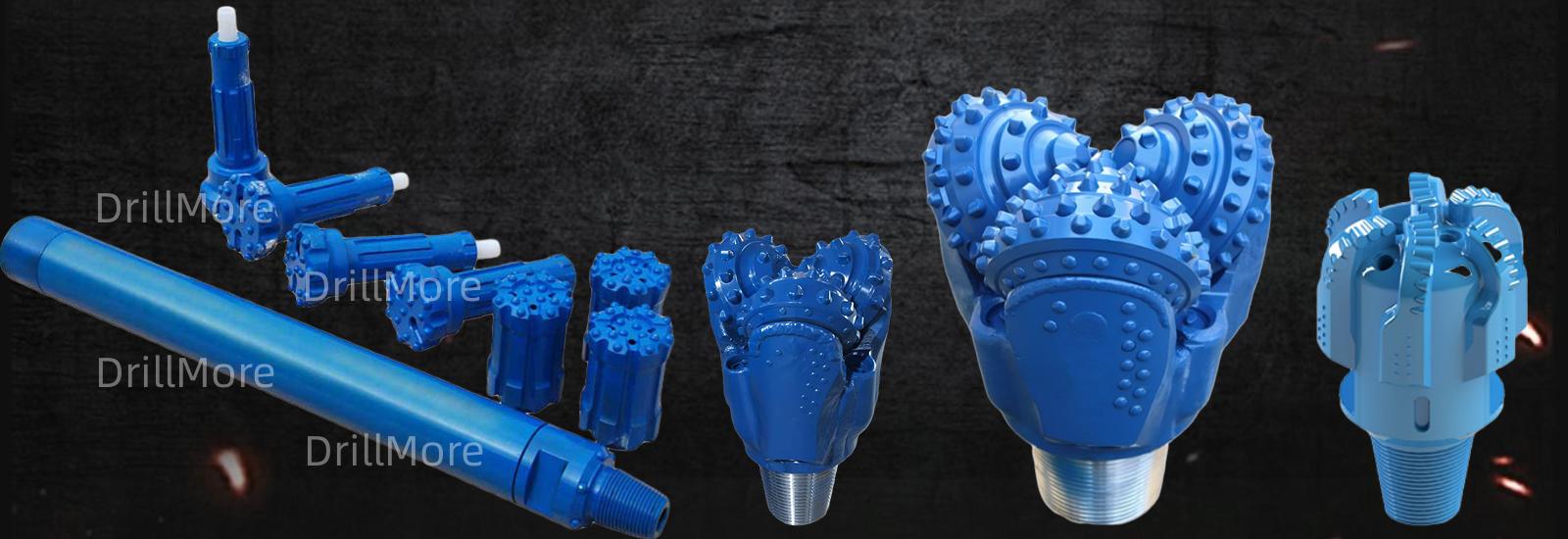
Drillmore supplying tricone bits, PDC bits, DTH hammers and drill pipes for water well, mining, geothermal and foundation drilling.
We provide professional technical guidance on drill rig & drill tool matching, IADC bit selection and thread/taper verification to prevent downhole accidents. With strict quality control, ready stock and customized service, we export our rock tools to over 50 countries. Our 24-hour technical team supports you to choose the right drill bits and pipes for your formation conditions.

Your email address will not be published. Required fields are marked with *


