
Common Construction-Related Issuesand Accident Prevention in HDD Crossing Il
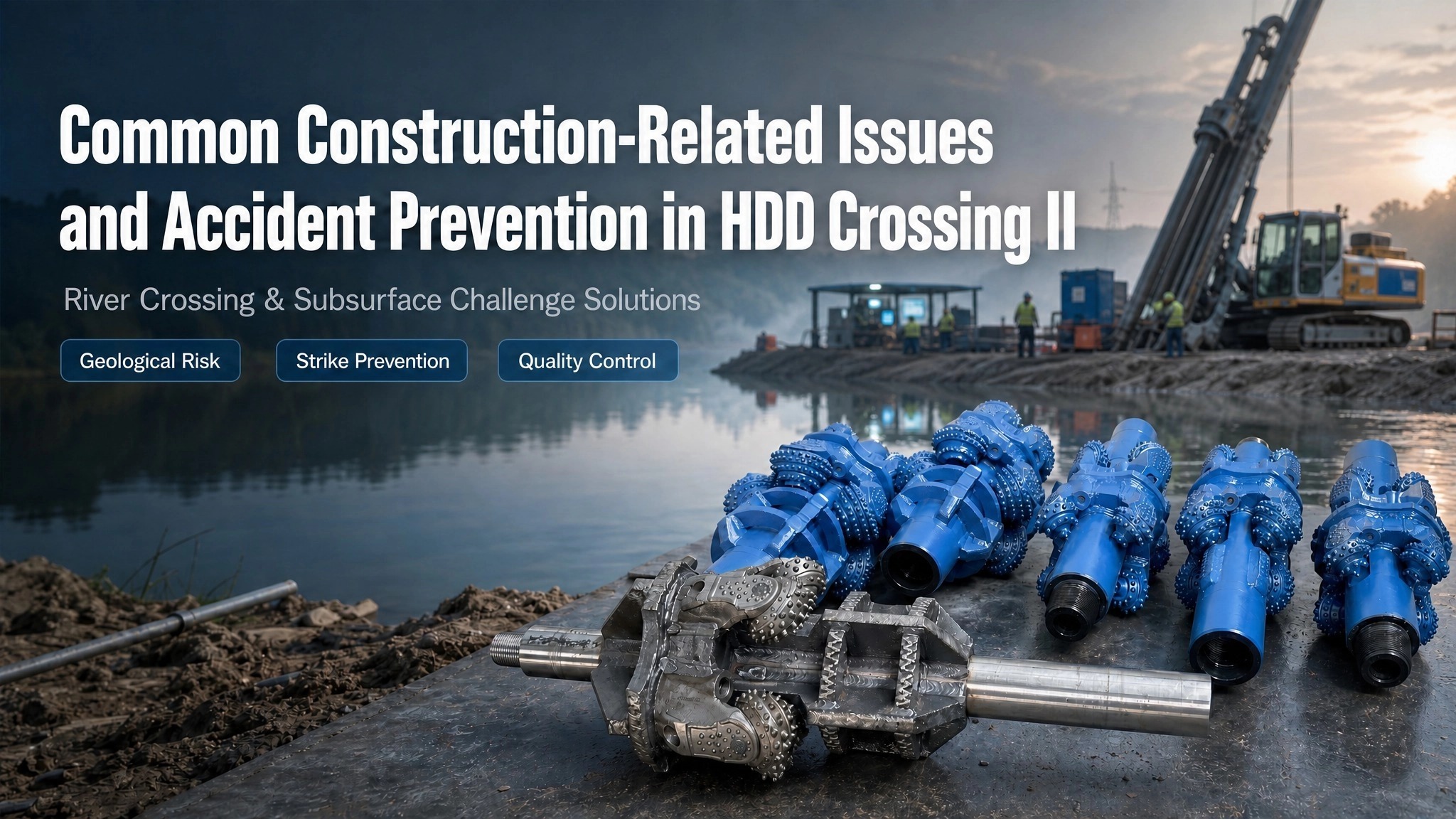
Common Construction-Related Issuesand Accident Prevention in HDD Crossing Il
3. Common Problems and Countermeasures for Pipe Pull‑back in Crossing Construction
3.1 Difficult Pull‑back or Pipe Stuck Caused by Unclean Borehole
Pipe pull‑back is the final procedure of crossing work and critical to project success. Many projects have failed due to unclean boreholes.
Main causes of unclean boreholes:① Unqualified mud properties such as viscosity and gel strength. ② Insufficient output of the mud pump. ③ Complex geological conditions.
Any of the above conditions may lead to difficult pull‑back or stuck pipe. Solutions are as follows:
Optimize mud properties during the final reaming or borehole cleaning before pull‑back. For favorable formations, keep mud viscosity above 55 s. For silty‑sand or fine‑sand formations, mud viscosity shall reach 75 s or higher. To obtain proper gel strength for borehole wall stabilization and collapse prevention, add appropriate fluid‑loss reducer to control mud filtration, and add lubricant to lower friction resistance.
When stopping drilling and restarting mud circulation mid‑operation, set mud output according to pump pressure. If pump pressure is high, start circulation at low output and gradually increase flow rate based on mud return condition. Sudden pressure surge may trigger borehole collapse or mud leakage. Adjust reaming speed according to returned‑mud density: with qualified mud viscosity, returned‑mud density over 1.10 means excessively fast reaming speed; density below 1.07 indicates too‑slow reaming speed, so increase reaming speed properly.
If reaming speed is already low, mud viscosity meets design requirements, yet returned‑mud density remains above 1.10, mud output is insufficient and flow velocity inside the borehole is too low. Raise mud output. If the mud pump has reached its maximum capacity, its performance is inadequate. Add extra mud pumps or replace with higher‑capacity units. Watch torque closely while adjusting reaming speed. Reduce rig pull force when torque is too high to avoid thread disconnection issues.
3.2 Pull‑back Failure Triggered by Improper Pipe Launching Method and Entry Angle
Pipe launching is often overlooked, with most attention paid only to pipeline anti‑corrosion coating protection. In practice, frequent construction accidents stem from unreasonable launching methods and incorrect entry angles.
Large net friction resistance occurs at the initial stage of pull‑back, which may fracture weak sections of drill strings. For example, the starting pull‑back resistance of the Fuhe Crossing in the Sichuan‑East China Gas Transmission Project reached about 100 tons, twice the normal pull‑back force. For long‑distance and large‑diameter crossings, the pipe‑floating launching method is recommended. Where floating‑pipe conditions cannot be met, use mechanical equipment for auxiliary launching. Improper entry‑angle handling due to elevation difference at pipe entry also frequently causes drill‑string breakage.
4. Preventive Measures for Mud Leakage in Large‑Scale Horizontal Directional Drilling (HDD) Crossings
During horizontal directional drilling construction, mud leakage commonly occurs in permeable and slightly‑permeable formations. It may heavily pollute ponds, rivers, roads, buildings and residences and result in high compensation claims. To guarantee construction quality, mitigate mud‑leakage risks and ensure site environmental protection, shallow‑layer mud‑plugging technology for HDD is urgently required on‑site.
4.1 Preventive Measures for Mud Leakage
4.1.1 Construction Process Measures
Use a relatively large‑size drill bit for pilot hole drilling. This creates larger annular clearance between drill collars and the bit, facilitates smooth mud return and reduces local pressure build‑up. Repeated drilling and pushing during pilot hole steering will form irregular annular spaces, which easily create sealed cavities and raise mud‑leakage risks.
Therefore, after completing each drill‑rod section, rotate and pull back for a short distance before resuming rotary drilling. This improves annular‑hole flow paths, lowers annular pressure and avoids mud leakage.
4.1.2 Mud Formulation
Add loss‑control materials for permeable and slightly‑permeable formations. Use high‑efficiency bentonite and increase additive dosage. Target mud properties: viscosity 55 s, density 1.03‑1.05, pH 9‑11, gel strength 2‑4/4‑8; returned‑mud density 1.07‑1.09.
4.1.3 Reaming Operation
If mud pressure rises sharply during reaming, reduce mud output and pull the reamer slightly backward to enlarge annular clearance. For silty‑sand and fine‑sand formations, fit more nozzles on the reamer, increase mud output and keep mud viscosity above 75 s. Maintain steady mud return, keep the borehole clean and prevent sand sediment from blocking flow channels, which would cause pressure build‑up and mud leakage.
4.1.4 Other Measures
Set temporary mud‑discharge points to reduce formation pressure and prevent water pollution for river, shrimp‑pond and lake crossings. Dig mud diversion ditches or mud‑storage pits about 50 m ahead of both entry and exit points to collect unavoidable spilled mud.
Abnormal mud return frequently occurs in long‑distance crossings, especially near the entry side. Poor mud return and mud leakage often take place around 40 m from the entry point due to trajectory inflection. Run casing strings to keep flow passages unobstructed.
Your email address will not be published. Required fields are marked with *


