
Risks & Notes for HDD Pipeline Crossing
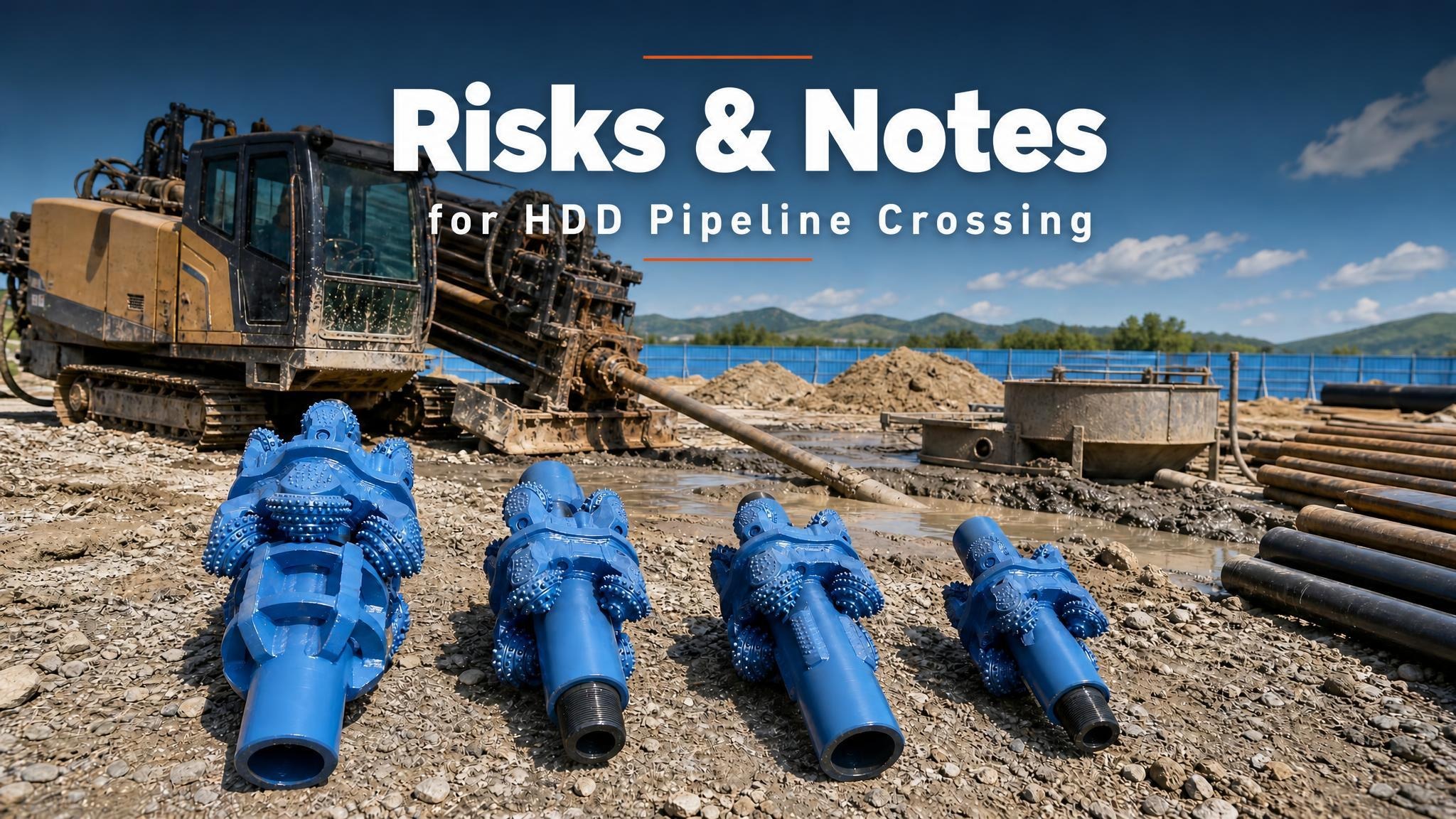
Risks & Notes for HDD Pipeline Crossing
(1) Analyze the self-stability of the strata being crossed to prevent ground collapse caused by hole formation.
(2) Analyze the soil density/compaction of the strata, select a suitable drilling mud pressure, and prevent slurry leakage/frac-out from polluting the environment.
(3) The preparation, use, recovery, and waste disposal of drilling mud must avoid environmental pollution. Discharged wastewater and waste solids must meet the national pollutant discharge standards. When HDD crosses important river embankments, slurry loss/frac-out must be prevented from adversely affecting the embankments. During construction, it is important to control the mud mix ratio and pressure; more importantly, before drilling starts, a detailed geological survey under the embankment should be carried out, and geological improvement measures should be adopted. This will also help the government water resources department approve the crossing design and construction plan.
(4) In areas where rock strata vary greatly, use different drilling speeds for different soft and hard strata to prevent the borehole from rising or sinking and forming an offset/misaligned borehole.
(5) According to different geological conditions and the size of drilled cuttings, reasonably set the mud density, viscosity, and flow rate.
(6) Before pullback of the pipe section to be crossed, complete the pressure test and anti-corrosion leak inspection, and it is advisable to perform calipering/ovality measurement. This prevents the pipe and anti-corrosion coating from being substandard after pullback, and prevents excessive ovality of the pipe from causing radial buckling instability.
(7) After pullback is completed, both ends of the pipe section should be sealed, backfilled, and compacted to prevent piping during floods and protect the safety of the embankments on both banks.
(8) During pilot-hole drilling, pay attention to the following:
① When drilling in weathered granite, if the bit encounters a rock vein/dike, or when drilling in a cobble layer it encounters a large cobble, the borehole path may clearly deviate from the design path, and the bit deviation may be difficult to predict. When operators notice small changes such as the bit encountering a hard object or difficulty in drilling, they should stop drilling immediately and check the bit position. At this time, reduce the weight on bit (WOB) and feed slowly so the bit can pass through the area slowly. During drilling, check the bit position frequently.
② When the bit encounters harder strata, it is usually necessary to increase the WOB. However, increasing the WOB may cause the drill pipe in the hole to bend. If the strata where the drill pipe bends are soft, the bent drill pipe may enlarge the borehole. The steering probe can only determine the bit position, and it is difficult to determine the borehole path formed by drill pipe bending. In this case, appropriately reduce the WOB, and try percussion drilling to pass through the hard strata. At the same time, increasing the pump flow rate or jetting may help soften the obstacle.
(9) During pipe installation after reaming, pay attention to the following:
① Reaming and pullback should be completed continuously in one pass as far as possible to prevent pipe sticking. If the reaming bit stays too long in the pilot hole, the bit may sink under its own weight because of its large weight.
② During slow pullback, too high a pump flow rate may create cavities in the soil or soften the soil around the pipe string.
③ The larger the reaming bit, the higher the probability that the bit will sink.
④ An increase in reaming resistance does not always mean that rotation speed or pump flow rate should be increased.
⑤ Drilled cuttings and borehole wall collapse will increase the resistance to movement of the drill string. At this time, it is very important to keep the reaming bit moving slowly.
(10) Pipeline instability and deformation during pipe pullback: During HDD pipeline pullback, the pipeline must withstand mud pressure or groundwater pressure, and the stability of the pipeline should be checked to avoid instability and deformation under external forces. If there is some pressure-test water left in the pipeline, the water may move inside the pipe and form a “piston effect” due to changes in pipeline curvature during pullback. If the pipe ends are closed, negative pressure may occur in some pipe sections, increasing the possibility of pipeline instability. Therefore, during pipeline pullback, avoid leaving water in the pipe; at the same time, injecting compressed air at a certain pressure into the pipe can help reduce the possibility of instability and deformation.
(11) When adding/connecting drill pipe during HDD drilling, use hydraulic power tongs. Do not use the rig inertia to make up the threads, as this can easily damage the drill pipe. Otherwise, a torque gauge should be installed on the drilling rig for control.
(12) When preparing the HDD construction plan, the construction contractor should actively communicate with the design institute to understand the design concept and key strength calculation results. This can effectively help prevent construction accidents.
Your email address will not be published. Required fields are marked with *


