
High Incidence of Bit Chipping & Lost Inserts! Avoid Construction Pitfalls to Greatly Extend Bit Service Life
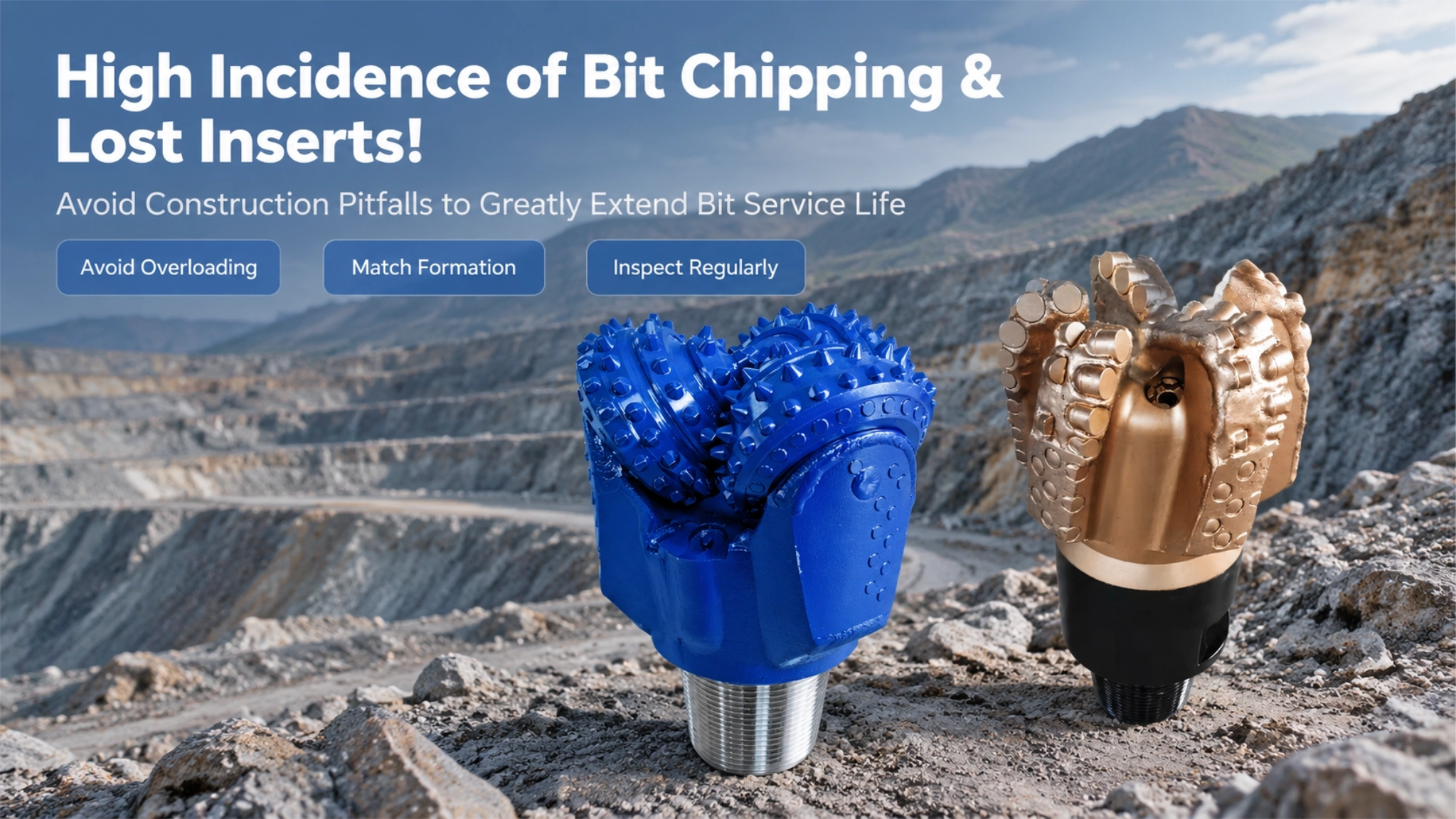
High Incidence of Bit Chipping & Lost Inserts! Avoid Construction Pitfalls to Greatly Extend Bit Service Life
Chipping and insert loss are two distinct issues.
Most job sites confuse chipping with insert loss, but they differ completely in root causes, damage locations and prevention methods. Statistics show chipping accounts for 55% of bit failure reasons, insert loss 25%, and other failures (gauge wear, matrix cracking, bearing damage) make up the remaining 20%. Separately addressing these two types of faults can extend bit service life by at least 50%.
Chipping means the PDC cutter itself fractures. It commonly occurs on the bit’s outer cone, shoulder and side cutting areas. There are three main causes of chipping: excessive drilling parameter loads, abrupt formation hardness changes, and inherent internal defects in the PDC cutter. The first two can be controlled at the job site, while the third is the manufacturer’s responsibility. A simple way to identify the root cause of chipping is to check the fracture location and direction. Chipping from parameter overload mostly appears on the outer cone, with fractures aligned with the drilling direction. Chipping caused by sudden formation changes usually occurs on the shoulder, with fractures perpendicular to the drilling direction. Chipping resulting from internal PDC cutter defects generally takes place at the cutter root, with fracture directions irregular.
Insert loss means the entire PDC cutter falls off from the bit. It usually occurs at the weld of the cutter pocket. There are four main causes of insert loss: unqualified welding technology, excessive fitting clearance when installing PDC cutters into the cutter pockets, weld cracking caused by water entering the cutter pockets during drilling, and impact collision during tripping in and tripping out. Compared with chipping prevention, avoiding insert loss relies more on the manufacturer’s production process and standardized on-site operation.
Avoiding Cutter Chipping & Insert Loss Through Proper Operation
To avoid the four pitfalls, veteran drillers follow five strict operational rules:
Grade Weight on Bit (WOB) by formation hardnessSoft formations (shale, mudstone): 6–8 t WOB; medium-hard formations (sandstone, limestone): 4–6 t WOB; hard formations (granite, basalt): 2–4 t WOB. When crossing formation boundaries, reduce WOB first then raise it. Each adjustment shall not exceed 2 tons. Do not use one fixed value for all strata.
Set rotary speed based on PDC cutter sizeΦ19 mm PDC cutter: Max 200 r/min Φ16 mm PDC cutter: Max 250 r/min Φ13 mm PDC cutter: Max 350 r/min Exceeding these limits creates centrifugal force that exceeds weld strength, tripling the risk of insert loss.
Tripping speed ≤ 1.5 m/sSlow down to 0.5 m/s near casing. Use jog operation within 5 meters of casing. This time-proven rule from senior drillers may look conservative, but it prevents 80% of insert loss failures.
Record torque, WOB and rotary speed curves every 50 meters drilled.Stop drilling immediately for inspection when anomalies occur (torque fluctuation > ±15%, sudden WOB jump > 2 t). After implementing this practice, the chipping rate dropped from 35% to 8%.
Inspect every bit upon delivery: visual check + rotation test.Visually check whether PDC cutter edges are chipped and if welds are full. Rotate to check for cutter wobble; clearance over 0.1 mm counts as non-conforming. This step helped the job site reject 10% of defective bits.
Field Results After Implementation
After applying the five rules, 5 pieces of Φ311 PDC bits completed 3 wells of 800 m depth before retirement. Average footage reached 480 meters per bit — three times higher than the previous 160 meters per bit. With a purchase price of $12,000 per bit, the site saved $36,000 in bit cost per well.
Closing Remarks: Parameters Are the Root of Cutter Chipping and Insert Loss
In most cases, cutter chipping and insert loss are not caused by defective bits, but improper operating parameters and non-compliant operations. Replace the "good enough" mindset with standardized operations, and your bit service life can double. Grade weight on bit by formation, set rotary speed according to PDC cutter size, control tripping speed properly, log data every 50 meters, and inspect each bit upon arrival. These five rules are simple, yet each directly improves footage per bit and reduces bit cost for each well. The next time chipping or insert loss occurs, do not rush to file a claim with the manufacturer. Check against these five rules first.


നിങ്ങളുടെ ഇമെയിൽ വിലാസം പ്രസിദ്ധീകരിക്കില്ല. ആവശ്യമായ ഫീൽഡുകൾ * എന്ന് അടയാളപ്പെടുത്തിയിരിക്കുന്നു


