
The Complete Process for Extending Drilling Tool Life! Bearing Lubrication, Cleaning, and Storage Can Cut Most Losses
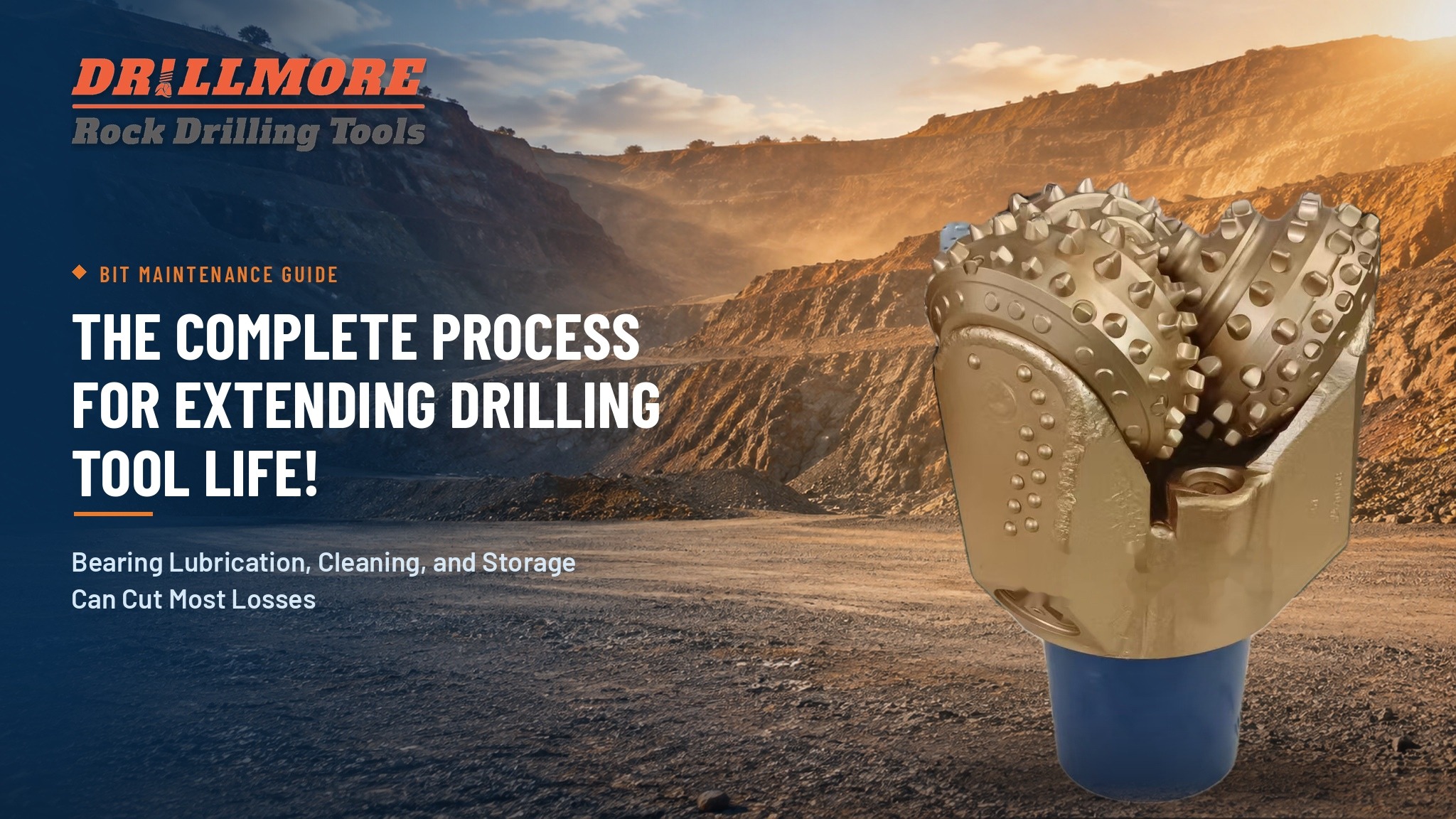
The Complete Process for Extending Drilling Tool Life!
Bearing Lubrication, Cleaning, and Storage Can Cut Most Losses
For drilling projects, the core of cost control is not simply squeezing procurement budgets. It is reducing unnecessary losses and extending the service life of equipment and consumables. Many construction teams face high annual costs for drilling tool purchases and equipment repairs: new drill bits wear out and are scrapped quickly after being put into use, while old drilling tools frequently fail and are repeatedly repaired. On the surface, this looks like normal wear caused by harsh site conditions. In reality, it is human-caused waste resulting from missing routine maintenance and non-standard storage management.
With the same type of drilling tools and the same construction conditions, teams that focus on refined maintenance can achieve a drilling tool service life more than 30% longer than conventional teams, while greatly reducing equipment failure rates. Extending drilling tool life does not require complicated professional techniques. A standardized process of cleaning, lubrication, storage, and pre-inspection can eliminate most unnecessary losses, effectively reducing construction costs and improving construction stability.
Drilling losses fall mainly into two categories: natural wear caused by geological formations and equipment cannot be avoided, but human-caused losses caused by inadequate cleaning, missing lubrication, disordered storage, and absent pre-inspection can be completely eliminated through standard operations. Maintaining routine maintenance is the most cost-effective way to reduce costs and improve efficiency in engineering construction.
Deep Cleaning After Operation: Prevent Corrosion and Wear from Residual Debris
After every construction operation and after drilling tools are disassembled, deep cleaning is the first step of maintenance—and the most basic step. During drilling operations, drill pipes, drill bits, bearings, and thread gaps will accumulate large amounts of mud, rock cuttings, sand, and corrosive impurities. If not cleaned in time, residual waste will continuously wear surfaces, block precision gaps, and corrode metal surfaces.
Long-term accumulation of impurities will gradually cause thread sticking, bearing seizure, drill bit dulling, and other problems, accelerating overall aging and scrapping of drilling tools. For routine cleaning, a high-pressure water gun can be used to flush the outer walls, holes and grooves, and thread gaps of drilling tools to thoroughly remove mud and waste residue. For small gaps such as bearings and precision interfaces, use a brush for deep cleaning to prevent impurities from remaining. After cleaning, dry the tools promptly to avoid rust and corrosion caused by moisture, laying the foundation for subsequent lubrication and storage.
Targeted Precision Lubrication: Focus on Protecting Bearings and Threads
Lubrication is the key to extending drilling tool life, especially for the two core wear-prone parts: bearings and threads. Precise and proper lubrication can greatly reduce friction loss and improve the equipment’s torsion resistance, rust prevention, and corrosion resistance. Many teams’ maintenance is merely formalistic—they simply smear on grease without targeted care, so it cannot provide effective protection.
As the core component that bears rotational force in drilling tools, bearings are highly prone to dry wear and seizure under long-term high-speed operation and friction. After each operation and before storage, apply special bearing grease to fill the internal gaps of the bearing and form a uniform protective oil film. This not only reduces starting friction and operating wear during the next operation, but also isolates air and moisture to prevent rust and corrosion. In high-frequency operation scenarios, bearings should be periodically disassembled for deep cleaning and grease replenishment to avoid dry aging.
For threads, focus on engagement lubrication. Apply special thread oil evenly across the entire thread surface to effectively avoid dry friction damage during assembly and disassembly, improve thread engagement tightness, and prevent thread rust, sticking, and stripping. This ensures precise and stable connection every time and prevents construction problems caused by connection failures.
Standardized Categorized Storage: Avoid Secondary Damage During Storage
A large amount of drilling tool loss on construction sites comes from improper storage. Random stacking, messy piling, and open-air placement can directly cause drilling tools to be bumped and deformed, threads to wear, moisture and rust to develop, and impurities to attach. Brand-new or nearly new drilling tools can be scrapped after being stored for a period of time, causing serious resource waste.
Standardized storage requires categorized and partitioned placement: drill bits, drill pipes, connectors, bearings, and other accessories of different specifications should be stored separately by category to avoid stacking, squeezing, and collision. Precision drilling tools must be equipped with protective covers, with key protection for wear-prone parts such as threads and tooth surfaces. Keep them away from open-air damp areas and sand accumulation areas, and place them in a dry, ventilated dedicated storage area to prevent rain corrosion and sand wear.
At the same time, a simple storage log can be established to manage tools by condition, specification, and model. Prioritize the use of old drilling tools and well-maintained tools to avoid long-term idle aging and maximize the use of every consumable resource.
Regular Deep Pre-Inspection: Avoid Hidden Failures in Advance
In addition to routine maintenance after operation, periodic deep pre-inspection is essential. After each construction cycle, check the wear level of drilling tools, bearing operating condition, and thread integrity one by one. For drilling tools with minor wear, sticking, or rust, repair and replenish maintenance in time to prevent small hidden problems from accumulating into scrapping failures. For drilling tools that are seriously aged, exceed damage limits, or cannot be repaired, eliminate and replace them in time. Never put damaged tools into operation, so as to avoid construction failures and safety risks from the source.
Drilling tool maintenance is never unnecessary busywork—it is a core method for reducing costs, improving efficiency, and keeping construction progress stable. A simple and practical full process of cleaning, lubrication, storage, and pre-inspection can greatly reduce human-caused losses, extend drilling tool service life, reduce downtime and repeated procurement costs, and make on-site construction more stable with more precise cost control.
Disclaimer: The drilling tool maintenance process in this article applies to general scenarios such as engineering drilling, geological exploration, and water well construction. Heavy-duty, heavy-load, and special drilling tools require dedicated maintenance standards. The content is for practical reference only and does not constitute the sole standard for equipment maintenance.
whatsapp:+86 19318344123
La teva adreça de correu electrònic no es publicarà. Els camps obligatoris estan marcats amb *


